
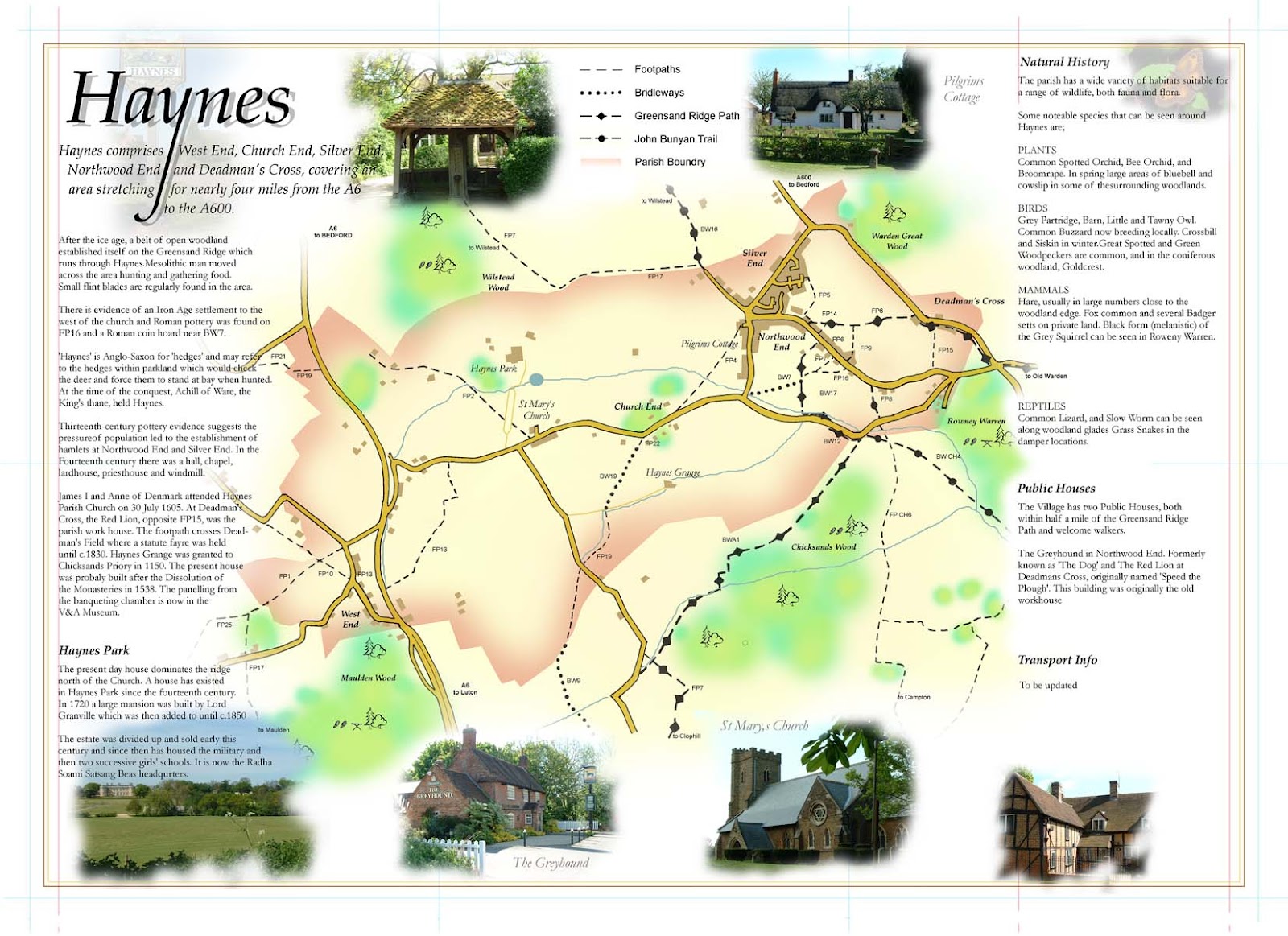
Information about the history of Haynes Parish starts in 1066 with The Doomsday
Book, in which Haynes is listed as “Hawnes” in the “Hundred of Flitton” Bedfordshire.
“Hawnes” was the Anglo-Saxon word for hedges, from which modern-day “Haynes”
is derived. The reference to hedges may be a link to hedges within the parkland
used to check the deer and force them to stand at bay when hunted. At the time of
the Norman Conquest, Achill of Ware, the King’s thane, held Haynes.
In early medieval time, the main village settlement was around the church, up to the
ridge to the North. It is thought that sometime in the thirteenth century, the expanding
population in Church End led to new hamlets at Silver and Northwood Ends.
Modern-day Haynes is a dispersed parish of four “Ends” with a “Cross” (West End,
Church End, Silver End, Northwood End and Deadman’s Cross), which developed
around the manor of Haynes Park. Haynes Church End is believed to be the
smallest conservation area in England.
Our local heritage also includes “The Grange Room”, from Grange Farm. Fine pine
panelling from a banqueting hall in the farm, possibly originally from Houghton
House (c1621), is now at the Victoria and Albert Museum in London. Huge oak
beams from nearby Chicksands Wood were used to support the Lantern Tower of
Ely Cathedral, and the “Haynes Hoard” of Roman coins and other artefacts are now
in Bedford Museum.
There are several interesting and important archaeological sites throughout the
parish, as well as the cross county Greensand Ridge walk and The Bunyan Trail.
There is much in Haynes parish worthy of conservation and environmental
protection.
The village today
Today the village of Haynes is classified by Central Bedfordshire Council (CBC) as a
“large village”. It supports a shop, a Post Office and a Public House. The population
of Haynes at the last census in 2011 was just under 1,200.
Haynes remains essentially rural in nature. It is located on The Greensand Ridge,
an area that contains many attractive villages, ancient woodlands, historic houses
and open parkland. Together, they provide a scenic rural landscape with many
viewpoints.